
#025: One Astronomical Unit, Please
Last week, the Cassini spacecraft concluded its 20 year mission by burning up in Saturn’s atmosphere. The craft was directed to do so from its command center on Earth to prevent any contamination of Saturn’s moons, which might harbour life.
The final transmission from the probe was received on September 15th, 2017 at 11:55:46 UTC. However, by that time, Cassini was already long dead. It took that signal travelling at light speed more than an hour to get from Saturn to us on Earth.
The sheer distances involved in astronomy, even within our own solar system, are hard to imagine for most of us. Unlike distances on Earth, which we can directly observe or experience in some way or another, we (currently) have no way to get an intuitive understanding for the distance between the earth and the moon, for example.
The confusion is furthered by the inaccurate representation of our solar system in pretty much any form of media you see, leading to a further warped sense of scale.
Think of a basketball (or even better, grab one if you have one handy), and imagine for a moment that we managed to shrink down the earth to this size (to be exact, a basketball the size of 23.8cm in diameter). Now grab a tennis ball, representing the also shrunken moon. Put the basketball earth on the ground, then place the tennis ball roughly where you would think the moon is in relation to the earth.
Odds are, you get this wrong. You most likely put the tennis ball anywhere around one meter distance to our basketball-sized earth. The actual, scaled distance between the basketball earth and the tennis ball moon is 7.3m. Most images depicting the Earth and the Moon together get this wrong, and put them together much, much closer. In reality, having the earth and the moon in one picture would look something like this:
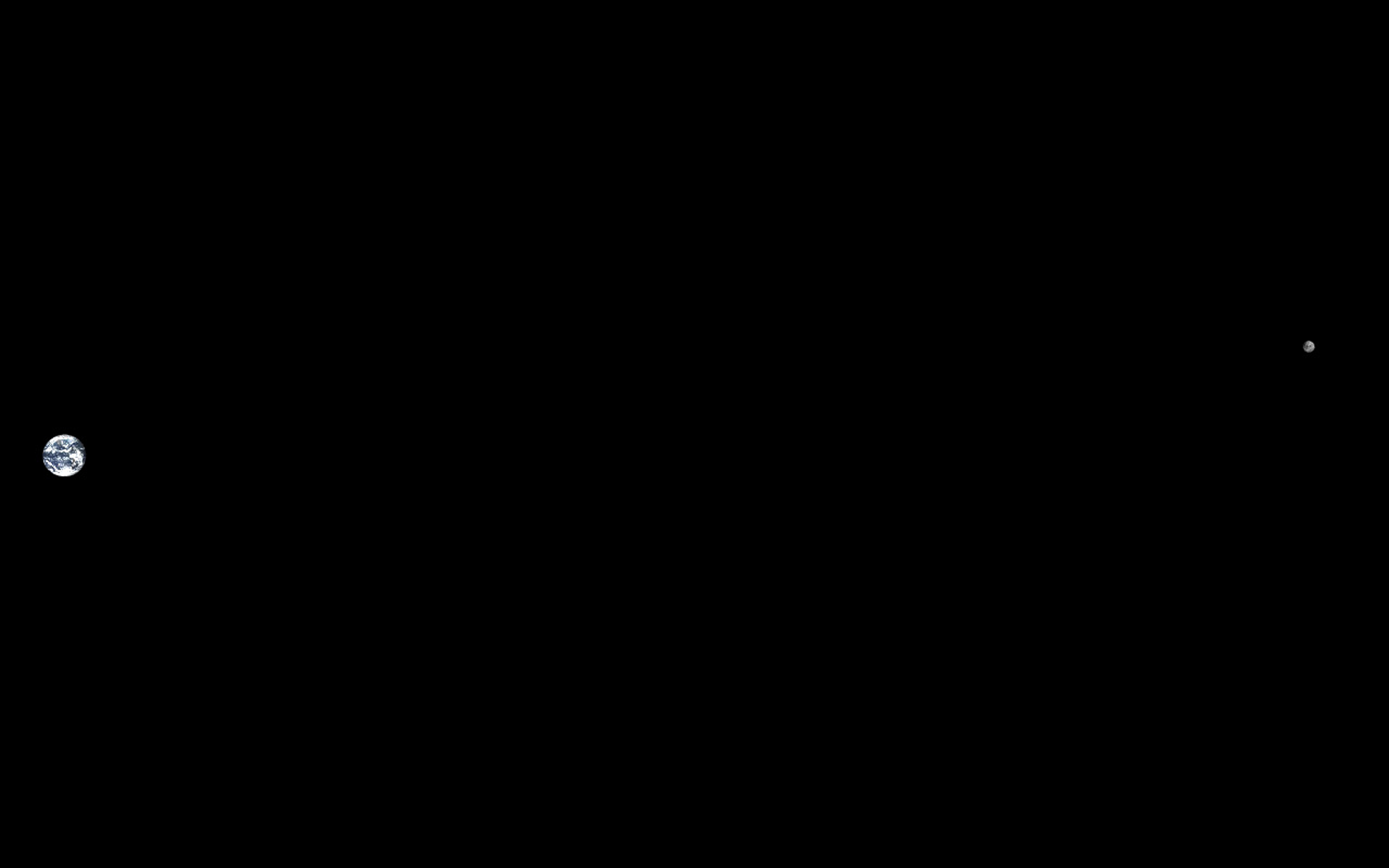
Now, let’s continue with our demonstration: How far away, and how big, would the sun be from our basketball earth? You would need to walk 2.8km to get to the sun from basketball earth, and once you got there, you’d be staring at a rather large ball of gas: 26m in diameter, or about the size of a very big house.
Going back, we pass Mercury (after 1.12km, about the size of an apple), then Venus (2km away, and the size of a large Hokkaido pumpkin), Earth, Mars (after 4.2km, and roughly the size of a honey dew melon), Ceres in the asteroid belt (golf ball sized, at 7.7km), and eventually reach Jupiter, our biggest planet in our system. Jupiter clocks in at around 2.6m in diameter - almost exactly the size of a Smart city car. And you’d want one by now anyway, because you have already put 14.5km distance between you and the Sun by now.
Keep walking (or driving), and you’ll eventually make it back to Saturn: 26.5km away from the sun, you would reach a gas ball the size of a very tall human, but only if you don’t count its rings. If you want to account for those, you would have to surround that person rings 2m wide. They would still be impossibly thin, though: Much less than 1mm at their thickest.
Reaching the next planet would require almost as much walking as to Saturn, because our third-largest, Uranus, is around 53km away from the sun, and about the size of a beach ball. And finally, we reach the last planet in our solar system: Neptune, after 84km of walking, where we arrive upon another beach ball sized planet.
If you wanted to visit the most famous dwarf planet, Pluto, you would need to keep walking even further: after 109km distance from the sun, you would encounter a golfball-sized sphere, with a moon, Charon, the size of a pea.
So, hopefully, dear reader, you now have a better appreciation for the distances in our solar system. But even with this scale, many distances in our universe remain unimaginably large: Our closest neighbouring star, Proxima Centauri, would still be over 750,000km away. Quite a walk.