
#102: Picturing Nothingness
We know that black holes exist, and have been able to observe them via radio and infrared telescopes for a long time. But we’ve never been able to actually directly observe one.
So, how do you take a picture of a black hole?
For one, a photograph means you’re capturing the photons bouncing off of an object, and a black hole will swallow all of them, by definition.
For another, there are no black holes in our immediate (astronomical) neighbourhood, so even if they were gigantic, to actually observe one, you’d need an equally gigantic telescope. Like, one as big as the Earth itself.
So when the Event Horizon Telescope project decided they wanted to take a picture of the supermassive black hole at the center of the M87 galaxy, they had to figure out how to do all of that.
We’re not going to build telescopes that big anytime soon, but astronomers have a trick up their sleeve: interferometry. It’s a technique where you use multiple telescopes to capture light from what you want to observe. The farther apart the telescopes, the better the resolution is going to be.
In the end, they chose 10 locations, from Hawaii to Europe, and from Greenland to the South Pole, effectively creating a telescope almost as large as the Earth. This “virtual” telescope is so sensitive, it could read the year stamped on a coin in Los Angeles from New York.
The telescope’s size brought new problems with it: In order to make sure that the photons gathered at each site came from the same source at the same time, the telescopes utilized atomic clocks and very precise GPS measurements over a long time, so that the measurements at each site could be precisely correlated.
But that doesn’t solve the other problem: black holes don’t emit light, they swallow it. So how do you take a picture of it?
The answer is: you can’t. At least not of the black hole itself. But every black hole has something called the event horizon. If a photon, which travels at the speed of light, crosses this threshold, it can never escape the black hole’s gravitational pull. It’s the ultimate point of no return, since nothing can travel faster than a photon. But some photons manage to orbit the black hole just above the event horizon, and eventually escape again. It’s these photons that the Event Horizon Telescope captured to observe the black hole itself.
In the end, the telescopes had collected over 5 petabytes of data (that’s 5.000.000 gigabytes, or about half a ton of hard drives). All of those hard drives were then shipped to two teams in Massachusetts, USA and Bonn, Germany, where the data was fed through advanced vision algorithms, and eventually assembled into this picture:
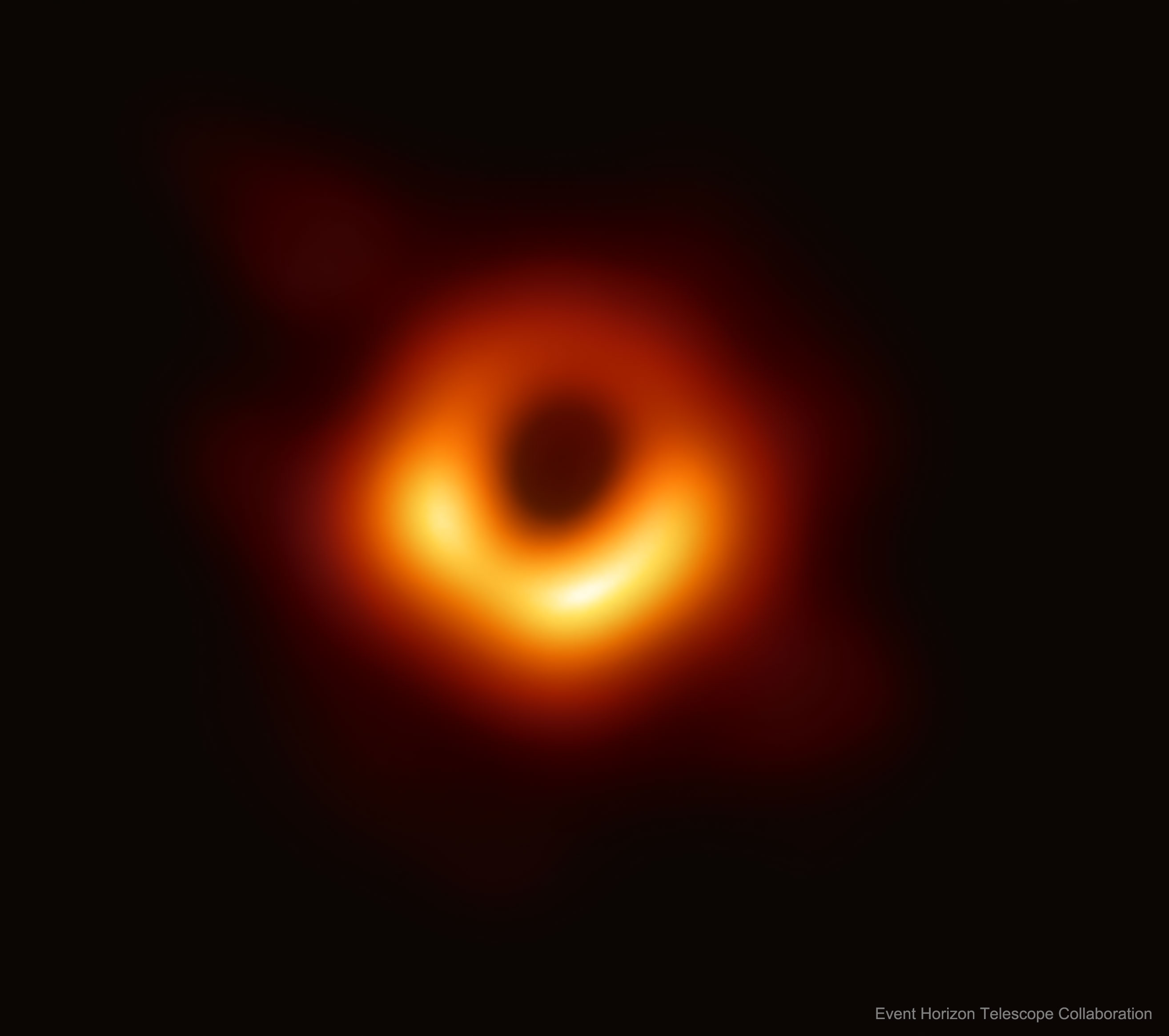 (Source: Event Horizon Telescope/NASA Astronomy Picture of the Day)
The dark spot in the middle is not the black hole itself, but its shadow, and the ring around it are the photons that just barely managed to escape. They glow orange as the black hole is surrounded by glowing gas, heated by the tremendous forces of the black hole.
The black hole itself isn’t that large (in astronomical terms, at least), roughly the size of our solar system, but with a mass equal to 6.5 billion times of our own sun:
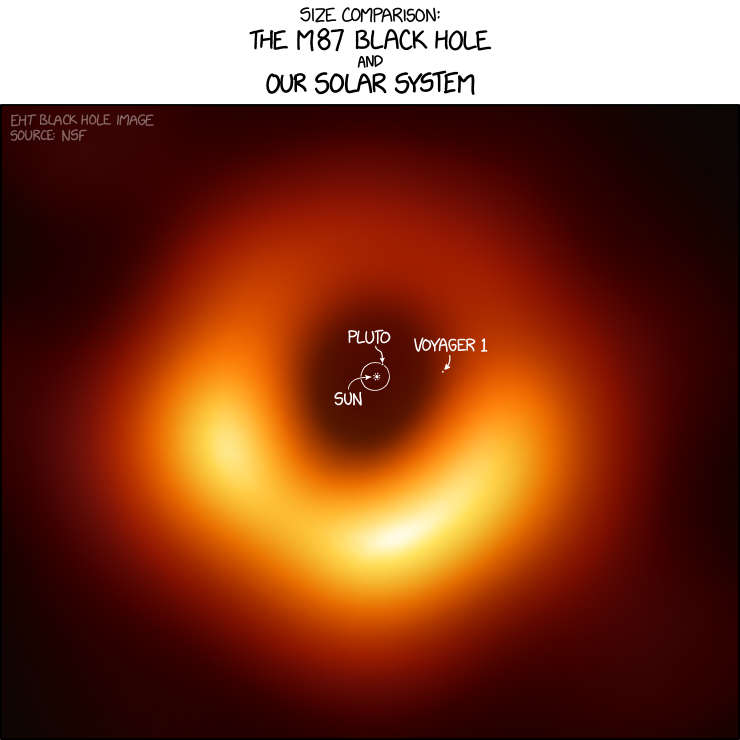 (Source: XKCD 2135)
The Event Horizon Telescope project isn’t done yet. In future observations, it aims to improve the resolution (so we get less blurry pictures), and observe other black holes — like the one in the center of our own galaxy.
Authentic Art
If you buy a piece of art, and you’re paying a lot for it, you’d like some assurance that it’s authentic. Usually, this means a gallery declares the authenticity of a piece, or if the artist is still alive, they too can vouch for their own work. But none of this works when the artist has decided to stay completely anonymous — like Banksy. So how do you know if you’re buying a real Banksy? How Banksy Authenticates His Work
Winter Cooking
Planning meals and placing orders are vital skills for any restaurant chef. Daily or weekly deliveries are what allows them to serve fresh and varied dishes to their customers. Lewis Georgiades, however, only gets one shot to order food and supplies. That’s because he’s cooking at the British Antarctic Survey’s Rothera Research Station, and the only way to get food delivered is via a supply ship once a year. And he’s cooking for people working in one of the most hostile environments on this planet, far away from friends, family, or even rescue: Researchers at This Base in Antarctica Eat Better Than You Do
Cheating Yourself to the Top
Donald Trump likes to boast his accomplishments far and wide. Among them are supposedly 18 golf tournament wins. How well does that claim hold up? Surprisingly, not at all. But it does tell us a lot about the most powerful man in the USA: Commander in cheat? Donald Trump’s 18 golf tournament wins examined.
📖 Weekly Longreads 📚
“She is venerated around the world. She has outlasted 12 US presidents. She stands for stability and order. But her kingdom is in turmoil, and her subjects are in denial that her reign will ever end. That’s why the palace has a plan.” ‘London Bridge is down’: the secret plan for the days after the Queen’s death